Open Nav



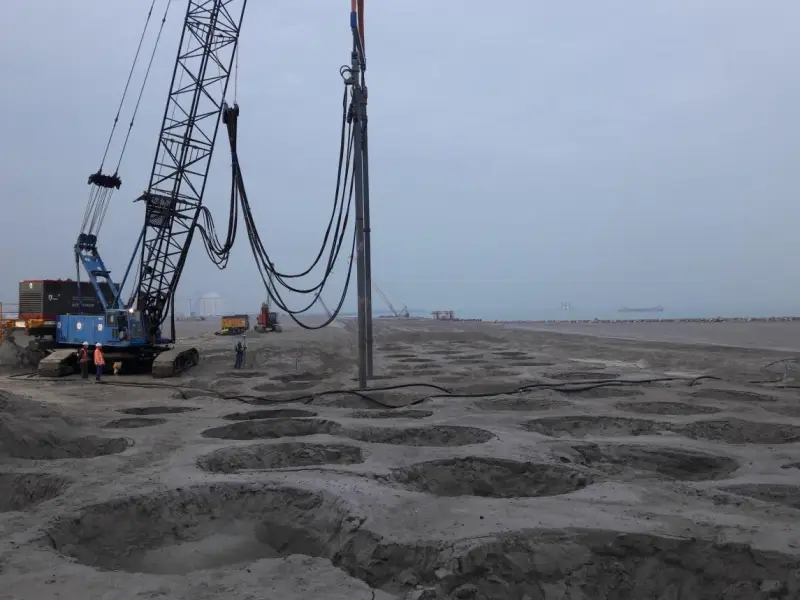
As mentioned earlier, there are three main methods for improving soft soil foundations, and the dy...
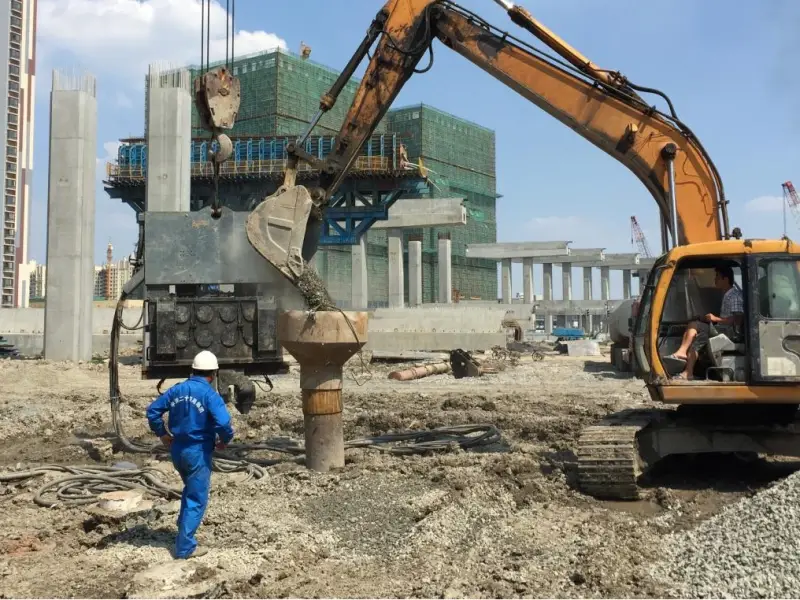
Soft ground improvement, also known as soft soil treatment or soft foundation stabilization, refer...
I. Introduction: Why Does the Vibratory Hammer Seem Fine, Yet the Job Still Doesn’t Go Smoothly?...
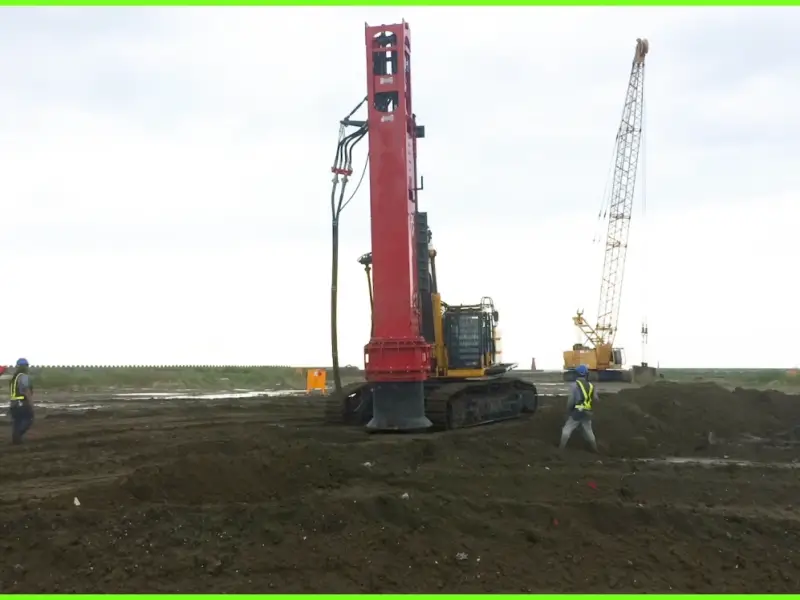
I. IntroductionIn the previous article, we introduced the three primary methods of soft ground...
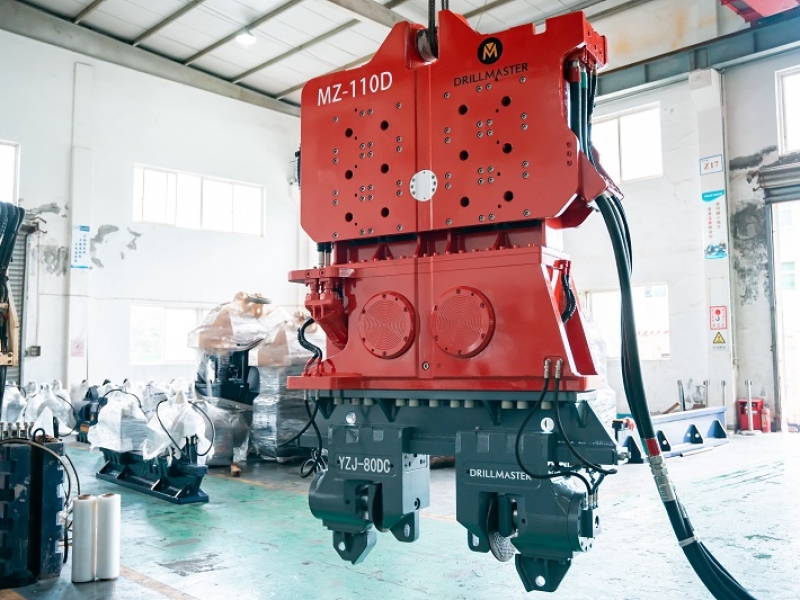
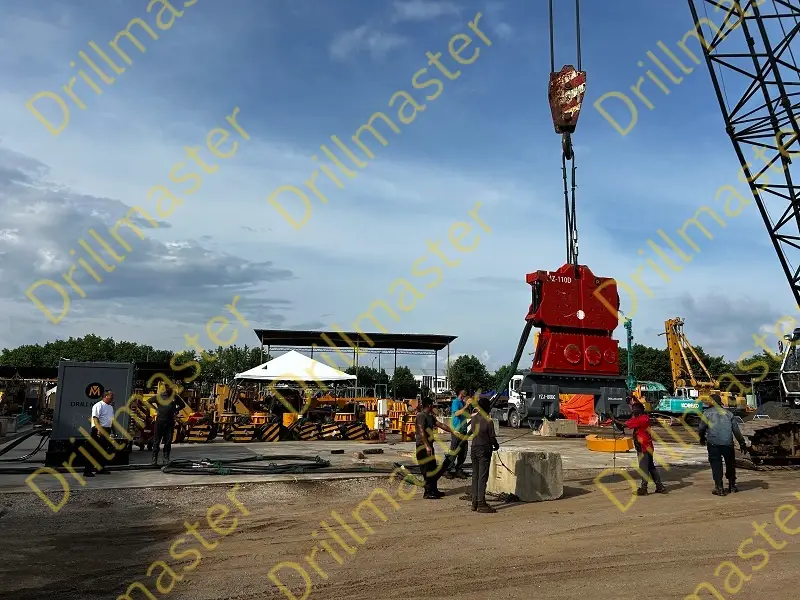
After strict quality inspection and tests, our hydraulic vibro hammer MZ-110D has been shipped to ...
As mentioned earlier, there are three main methods for improving soft soil foundations, and the dynamic compaction method has been introduced. This paper will analyze the most common problems encountered during the construction of the second method—the vibroflotation method—as well as the key considerations that are most easily overlooked during the construction process.
The principle of the vibroflotation method can be summarized as the combination of "vibration" and "flushing," and depending on the soil type, it functions primarily through two mechanisms:
1. Vibro-compaction: Mainly applied to sandy soils. The powerful horizontal vibration of the vibrator causes liquefaction in saturated sands, allowing soil particles to rearrange under gravity, reducing the void ratio and thereby densifying the soil.
2. Vibro-replacement: Mainly applied to cohesive soils. After forming holes by vibroflotation, coarse granular materials such as gravel are backfilled into the holes to form high-strength stone columns. These columns, together with the surrounding soft soil, form a composite foundation, with the columns bearing the majority of the load.
Today we will focus on the vibro-replacement method (stone column method).
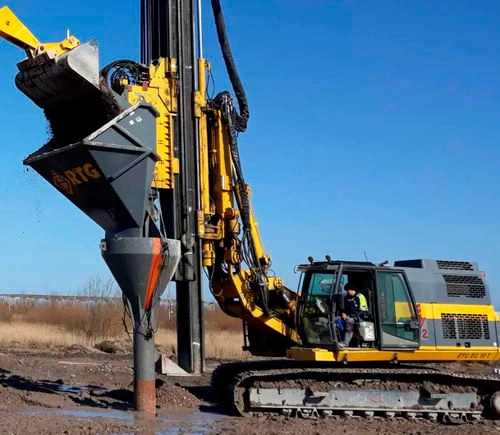
Applicable soil types: Cohesive soils, silty soils, saturated loess, artificial fill, etc.
Key criterion: The soil’s undrained shear strength should not be less than 20 kPa.
Core mechanism: Replacing part of the soft soil with stone columns to form a high-strength composite foundation.
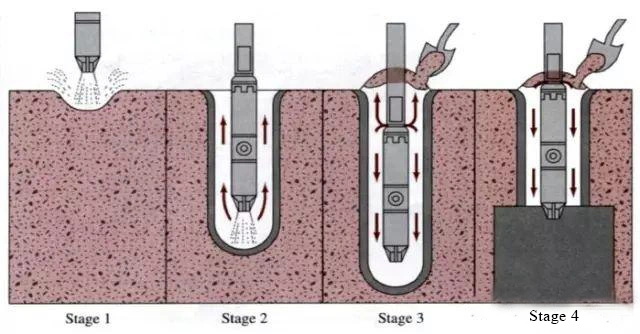
Positioning: The crane lifts the vibrator and aligns it with the designated pile position.
Hole forming: The vibrator and high-pressure water pump are activated. Under the combined action of vibration and water jetting, the vibrator sinks to the designed depth. The sinking speed is generally 1–2 m/min.
Hole cleaning: The vibrator is lifted out of the hole, and circulating water is used to flush out the slurry from the hole, ensuring a clean hole bottom.
Backfilling: Gravel or other materials are fed into the hole in batches.
Compaction and pile forming: The vibrator is lowered again into the backfill layer to vibrate and compact it. This process is carried out from the bottom upward in successive layers until a complete stone column is formed. A gravel cushion layer of 300–500 mm thickness is usually placed on top of the pile.
- Excessively low strength of the foundation soil: When the vane shear strength of the soft soil is below 20 kPa, the lateral wall friction on the vibrator is extremely small. Under its own weight and vibration, the vibrator tends to "bog down" and cannot form a stable hole wall. In this case, high-pressure water flushing exacerbates the erosion and failure of the hole wall, causing large amounts of slurry to surge into the hole and creating a "rubber soil" phenomenon, which prevents further hole formation.
- Encountering hard soil interlayers: When lens-shaped dense silty soil, silty sand, or calcareous nodule layers are distributed within the soft soil, the vibration energy of the vibrator may not penetrate these hard strata, leading to a sharp decrease or even stagnation in penetration speed. Prolonged forced vibration may damage the bearings or motor of the vibrator.
- Improper control of water pressure and flow rate: During hole forming, if the water pressure is too high, the high-pressure jet will directly cut and scour the hole wall, undermining its stability and causing collapse. If the water pressure is too low, it cannot effectively lubricate or carry soil cuttings upward, resulting in excessive sediment at the hole bottom, which may also cause sticking or burial of the drill tool.
Solutions:
- For soft soils with excessively low strength: Use large-diameter gravel (e.g., 200 mm) for construction, or adopt special techniques such as bagged sand-gravel piles or bamboo-cage sand-gravel piles.
- For hard soil interlayers: Adopt the scheme of "pre-boring with a percussion drill followed by vibroflotation"—first pre-bore a hole at the hard interlayer position using a percussion drill, then proceed with the vibrator.
- For improper water pressure control: During hole forming, control the water pressure at 200–600 kPa, the water flow at 200–600 L/min, and the hole-forming speed at 0.5–2.0 m/min.
Preventive measures:
- Conduct field pilot pile tests before construction to determine the optimal water pressure, flow rate, hole-forming speed, and other parameters suitable for the specific site.
- For soft soil foundations with vane shear strength below 20 kPa, pre-assess whether the vibro-replacement method is suitable. If necessary, consider preloading treatment to improve soil strength before construction.
- Excessively close pile spacing: When the designed pile spacing is less than 1.5 times the pile diameter (especially in muddy soft soils), the excess pore water pressure and vibration waves generated during the construction of a single pile are rapidly transmitted through the soil, causing squeezing or vibrational damage to adjacent piles that have not yet fully consolidated.
- Lateral transmission of high-pressure water and vibration: The high-pressure water and intense vibration from the hole under construction create a "liquefied zone" around it. If an adjacent pile has just been formed and the gravel has not yet been firmly encapsulated by the soil, the gravel can easily be lost and the pile diameter can shrink within this liquefied zone—a phenomenon known as cross-hole interference. In severe cases, it can even lead to the complete failure of the adjacent pile.
- Unreasonable construction sequence: If piles are constructed continuously row by row rather than by skip-filling or interval construction, the previously installed piles—which have not yet regained their strength—are subjected to strong disturbance from later piles, easily triggering widespread cross-hole interference.
Solutions:
- Once cross-hole interference occurs, construction in the adjacent area should be stopped immediately. Work should resume only after the excess pore water pressure in the disturbed soil around the affected piles has dissipated and the soil strength has recovered.
- For adjacent piles that have been affected by cross-hole interference, re-compaction should be carried out. If necessary, additional piles should be installed to ensure that the bearing capacity of the foundation meets the design requirements.
Preventive measures:
- Choose a reasonable construction sequence. The skip-filling method (constructing every other hole in each row) or the curtain method (first constructing the outer 2-3 rings of holes, then the inner rings) is recommended.
- Increase pile spacing appropriately to avoid excessively close spacing that causes mutual interference.
- Control the water flow rate during hole forming and compaction to avoid excessive softening of the soil around the piles.
- Prefer crawler cranes over truck-mounted cranes for construction. The mast of a crawler crane provides better stability, reducing pile deviation caused by mast deflection.
- Lax implementation of construction parameters:
Compaction current not reaching the required value: The compaction current reflects the resistance of the vibrator when vibrating in the backfill layer and is a direct indicator of compaction quality. If vibration is stopped prematurely to speed up progress (insufficient holding time) or if the set current value is too low, the gravel in the pile body will remain loose.
- Insufficient backfill volume: If the actual gravel volume fed into the hole is less than the designed bulking volume, the pile diameter will be smaller than designed, resulting in inadequate squeezing of the surrounding soil and weakening the replacement effect.
- Unsuitable grading and particle size of the backfill:
Excessively large particle size (e.g., >200 mm): In a narrow hole, large gravel particles tend to form "bridges," creating voids between them that are difficult to compact, leading to high internal porosity.
- Excessively small particle size (e.g., <20 mm with high fines content): Fine particles are easily carried away by the circulating water during sinking. When the remaining coarse particles are compacted, the lack of fine fillers prevents them from achieving maximum density.
- Weak lateral confinement at the pile top: In the top section of the pile (0.5–1.0 m below the surface), the overburden pressure is insufficient, and lateral confinement is lacking during compaction. As a result, the gravel pile tends to be "scattered" or "opened up" by vibration, forming a loose zone at the pile head—this is the weakest link most likely to be exposed during bearing capacity testing.
Solutions:
- If the compaction current does not meet the requirement: Re-insert the vibrator into that section and perform supplementary compaction until the stable current reaches the specified compaction current value and the holding time meets the requirement (generally at least 30 seconds).
- If the backfill volume is insufficient: Add more gravel to that section and re-compact it, ensuring that the backfill volume for each section meets the design requirement.
- If the pile top is loose: Strengthen compaction specifically at the pile top; if necessary, increase the backfill volume and holding time for that section.
Preventive measures:
- Prior to construction, field pilot pile tests must be conducted to determine core parameters such as the compaction current value, holding time, and backfill volume per section.
- Strictly control the particle size of the backfill: oversized particles are difficult to feed into the hole, while undersized particles are difficult to compact. Use hard, stable aggregates as backfill.
- The thickness of each backfill layer should not exceed 500 mm; compact layer by layer from the bottom upward.
- Record the compaction current, holding time, and backfill volume at each depth in real time during construction to ensure that each section meets the specified values.
Because vibroflotation is a concealed operation, its spatial positioning accuracy is affected by multiple factors.
- Difficulties in underwater and underground positioning: The vibrator is suspended by a wire rope and operates in holes tens of meters deep. Surface pile markers can only control the position at the collar. In strata with variable stiffness, the vibrator is subjected to lateral forces during sinking, causing it to deviate.
- "Deflection" caused by alternating soft and hard layers: When the vibrator penetrates from a soft layer into a hard interlayer, or from a hard layer into a soft layer, the abrupt change in resistance at the interface tends to deflect the vibrator tip toward the softer side, resulting in pile inclination.
- Insufficient stability of the lifting equipment: Uneven platform or crane positioning, or displacement under the reaction force of vibroflotation, can directly cause the guide mast to tilt, making the hole verticality exceed the allowable limit of 1%.
Solutions:
- If deviation is caused by uneven soil conditions: Start hole forming from the harder side to correct the deviation, or pour backfill on the softer side to prevent further deviation.
- If deviation is caused by improper tension in the pull ropes: Adjust the direction and tightness of the ropes.
- If the guide pipe is bent or not installed vertically: Adjust the alignment of the vibrator and the guide pipe to vertical; straighten or replace a bent pipe.
- If deviation is caused by one-sided backfill extrusion: Change the backfilling direction and feed the material evenly from all sides around the hole.
- If the pile position deviation after pile formation exceeds the allowable value specified in the code (should not exceed 0.2 times the pile diameter), re-drill a hole at the correct position and form a new pile with densification.
Preventive measures:
- Before hole forming, ensure that the deviation between the water-jet center of the vibrator and the pile-hole center is less than 0.2D (where D is the pile diameter).
- Strictly control verticality deviation during construction to no more than 1/100.
- Mark length graduations on the vibrator and guide pipe (generally every 0.5 m) to facilitate depth control by operators.
- Use a crawler crane with good stability as the lifting equipment to reduce the effect of equipment sway on verticality.
This is a systematic error caused by poor on-site organization and management.
- Disorganized construction management and lack of records: On large construction sites with many piles and dense layouts, if a scientific numbering system and real-time marking methods (such as flag placement or lime powder marking) are not adopted, and the work relies solely on memory, individual pile positions can easily be missed.
- Inadequate process handover and re-surveying: The construction site is usually muddy, and the markers for completed piles are often damaged, covered, or contaminated. If surveyors do not re-survey and re-mark the positions in time, the construction crew may create blind spots when moving equipment, resulting in missing holes and, ultimately, local weak zones during bearing capacity testing.
Solutions:
- Once a missing hole is found, immediately install a pile at the missed position to ensure full coverage of all designed pile locations.
- The replacement pile should be constructed using the same construction parameters and quality standards to ensure its quality matches that of the original piles.
Preventive measures:
- Number all hole positions before construction and establish a complete pile position ledger.
- Conduct timely re-inspections during construction; clearly mark completed piles (e.g., with flags, lime powder, etc.).
- Adopt a systematic construction sequence (row-by-row method, skip-filling method, or curtain method) and advance row by row in order to avoid omissions caused by site chaos.
- Surveyors should regularly re-measure and re-place markers for those that have been damaged or covered.
BackOur professional team will reply you as soon as possible.
 English
  Español
 العربية