What is a vibratory hammer?
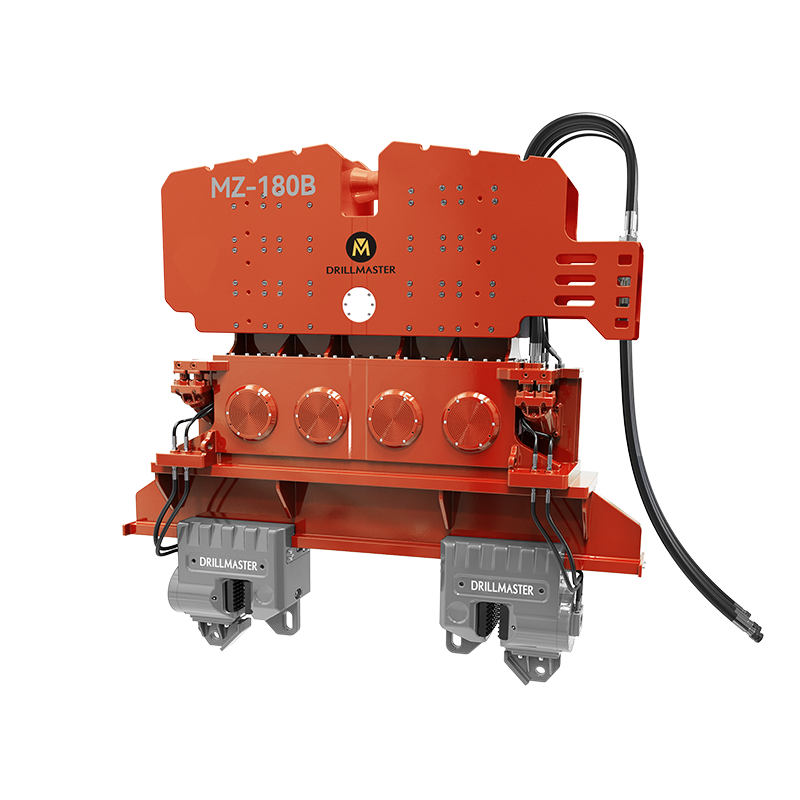
A vibratory hammer is a type of pile-driving equipment used for vibration piling. Its basic components include: hammer head, power pack, clamp, hydraulic hoses, remote controller, optional self-cooling system, and wireless remote control.
What is the function of the self-cooling system?
It cools the gear oil to prevent high temperatures inside the hammer that could damage internal bearings and seals. By avoiding overheating, the hammer can operate continuously.
What are the three operation modes of the vibratory hammer power pack?
Remote control, wired control, and panel operation.
What is the vibration damping method of the electric vibratory hammer?
Spring damping.
What is the difference between spring damping and rubber block damping?
Spring damping is stiffer than rubber damping and provides less damping and shock absorption, but it is more cost-effective.
How many types of crossbeams does the vibratory hammer have?
There are four types: straight beam, double-section small beam, X-shaped beam, and cross-shaped beam.
Application Scenarios (Construction Methods) of Vibratory Hammers
Municipal projects, port and terminal construction, onshore photovoltaic projects, offshore photovoltaic projects, offshore wind power, offshore oil and gas projects, and soft ground improvement.
What types of piles can a vibratory hammer drive?
Larssen sheet piles, H-beams, I-beams, steel pipe piles, concrete sheet piles, concrete pipe piles, concrete square piles, and other special-shaped sheet piles.
What are the types of soft ground improvement methods?
Vibro stone columns, sand compaction piles, rapid impact compactors, and drop hammers.
What is the main purpose of a single clamp on a vibratory hammer?
It is mainly used for driving Larssen sheet piles, I-beams, and H-beams.
What types of projects are resonance free vibro hammers suitable for?
Projects with sensitive foundations.
What are the three core features of a hydraulic resonance free vibro hammer?
No resonance during start and stop, high rotation speed, and adjustable eccentric moment.
What is the after-sales service period for a vibratory hammer?
1,000 working hours or one year, whichever comes first.
What is the SPT value?
The Standard Penetration Test (SPT) value in dynamic probing.
What is the core principle of pile extraction using a vibratory hammer?
Vibration reduces soil friction and loosens the surrounding soil, allowing the pile to be pulled out.
What is the function of the water jet system?
In sandy or silty clay soils, it uses high-pressure water to pre-drill and assist pile insertion.
What is the purpose of counterweights on a vibratory hammer?
To increase the hammer’s weight and improve its ability to overcome end-bearing resistance of the pile.
Can a vibratory hammer drive inclined piles? What is the maximum inclination angle?
Yes, typically the inclination angle is less than 15 degrees.
What types of machines can a vibratory hammer be mounted on?
Excavators, cranes, rotary drilling rigs, and piling rigs.
How many types of vibratory hammers are there?
Excavator-mounted vibratory hammers, electric vibratory hammers, and crane-mounted vibratory hammers.
Is the diameter of an impact hammer’s pile cap fixed?
No, it can be adjusted with adapter strips, bolts, or modular components.
What do numbers 3, 4, 5, and 6 refer to in Larsen steel sheet piles?
The "model" of Larsen steel sheet piles (such as No. 3, No. 4, No. 5, and No. 6) primarily refers to their cross-sectional dimensions and mechanical properties. These models are distinguished mainly by parameters such as width, height, and thickness.
What is the meaning of
Combinations of steel sheet piles with steel sections, and steel sheet piles with steel pipe piles.


 English
  Español
 العربية